Vine Denoising Copula (VDC)
Amortized vine copulas for high-dimensional density and information estimation




Paper · Documentation · Quick start · Pretrained models · Reproduce the paper
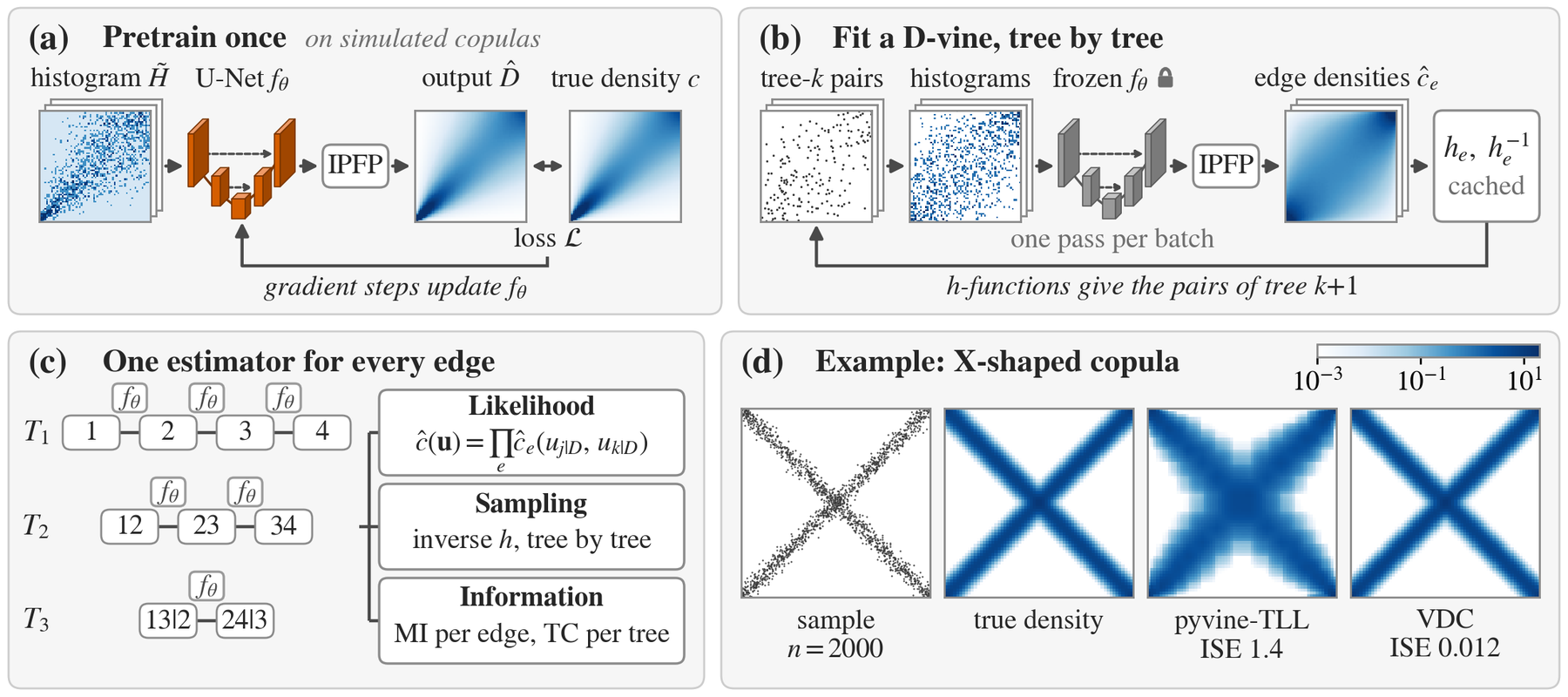
Vine copulas model high-dimensional dependence through a tree of bivariate pair-copulas, but classical fitting estimates every edge separately, which becomes the bottleneck as dimension grows. VDC trains one bivariate denoising network on simulated copulas and reuses it for every edge: it maps the empirical histogram of an edge to a density grid in a single forward pass, and an IPFP (Sinkhorn) projection restores uniform copula marginals. The fitted pair-copulas and their cached h-functions plug into standard vine recursion, so the model keeps an explicit, interpretable dependence structure while replacing repeated per-edge fitting with reusable neural inference.
What you can do with it
- Estimate a bivariate copula density from samples in milliseconds.
- Fit D-, C- and regular vines in high dimensions, with batched GPU inference.
- Evaluate likelihoods, draw samples (inverse Rosenblatt), and compute conditional transforms.
- Estimate mutual information and total correlation, decomposed by edge and by tree of the fitted vine.
- Train your own estimator on the included synthetic copula generators.
Results at a glance
From the NeurIPS 2026 paper (all numbers use the released
vdc-denoiser-m64-v1):
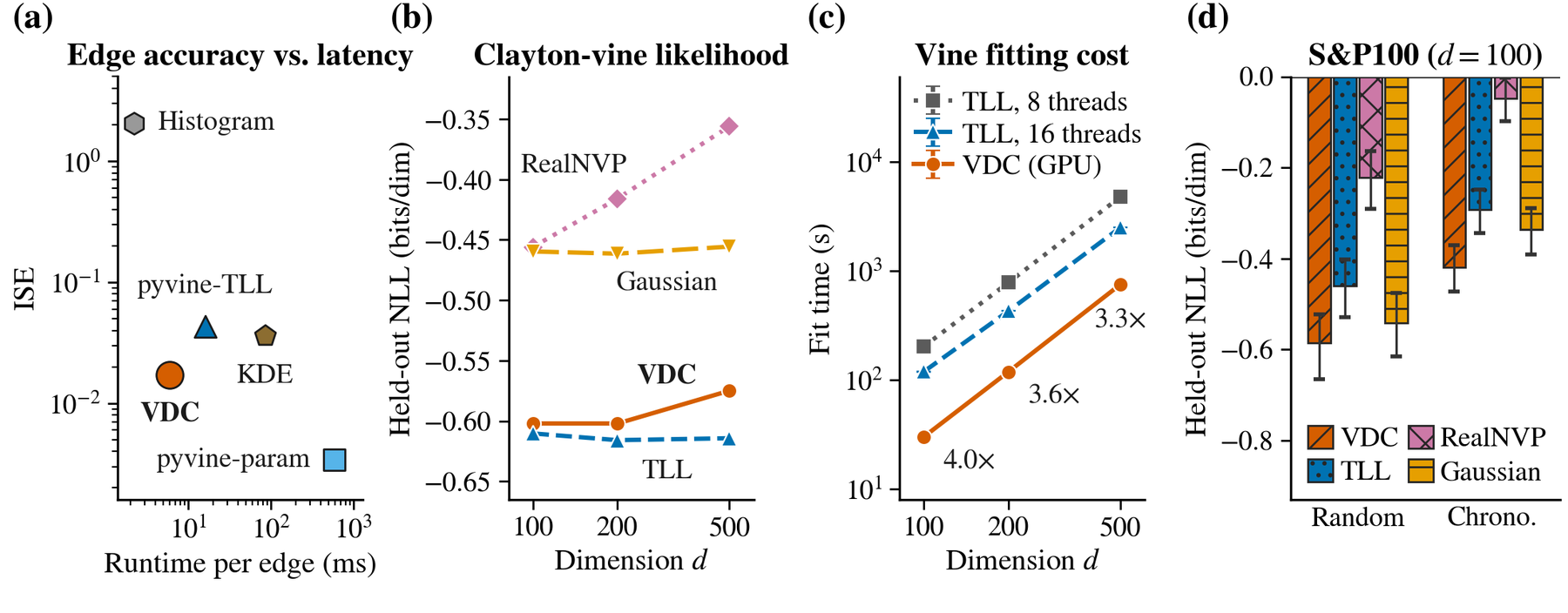
| Bivariate density (9 in-library cases) | lower ISE than histogram, KDE and pyvine-TLL at ~6 ms per edge on a GPU; parametric family selection is more accurate on its own families at ~100x the cost |
| Families never seen in training | matches per-case TLL refits in held-out likelihood and roughly halves MI error |
| High-dimensional vines (d = 100–500) | 3.3–4.0x faster than 16-thread pyvine-TLL on one node (749 s vs 2,489 s at d = 500) |
| S&P100 daily returns (d = 100) | best held-out likelihood of the compared methods on random and chronological splits |
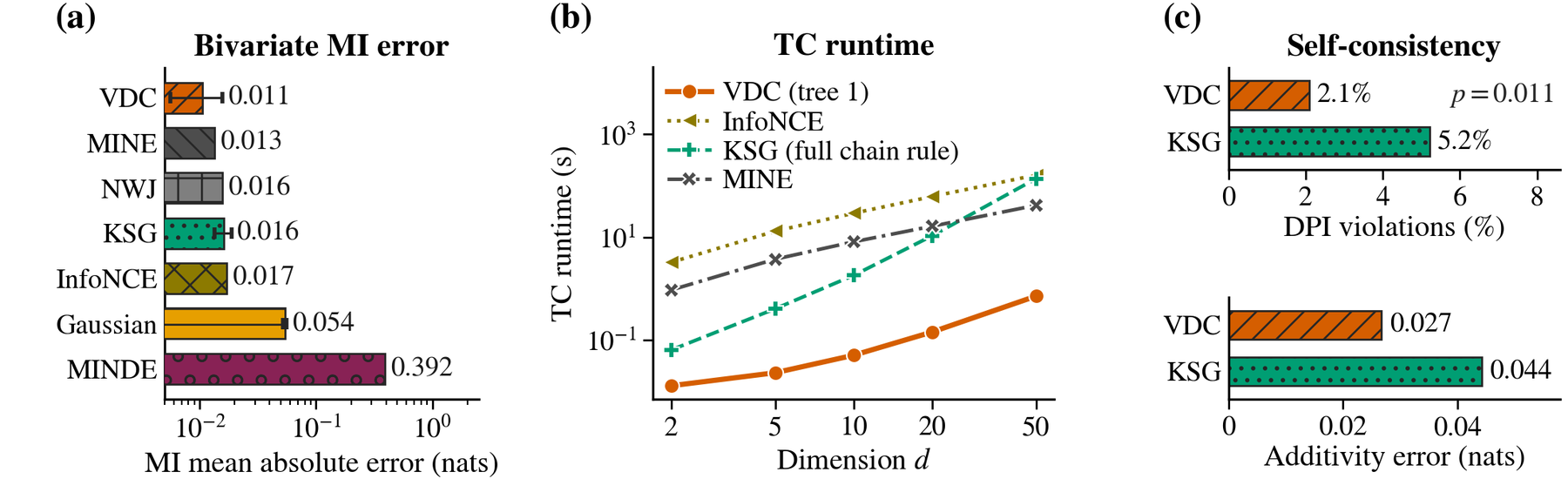
| Information estimation | fewer data-processing-inequality violations and lower additivity error than KSG; TC at d = 50 in 0.71 s |
Limits are reported alongside: the 64x64 grid bounds accuracy for near-deterministic pairs, and chained conditional prediction (VaR, imputation) is not yet competitive. See the paper and the reproduction guide for every protocol.
Installation
python -m pip install vine-denoising-copulaPython 3.11 or later with PyTorch 2 is required. A GPU is optional. The base install supports pretrained pair densities, vine fitting, likelihoods and sampling without pyvinecopulib or plotting/training packages. Optional features:
python -m pip install 'vine-denoising-copula[train]'      # synthetic data and training
python -m pip install 'vine-denoising-copula[baselines]'  # qualified pyvinecopulib 0.7.x
python -m pip install 'vine-denoising-copula[viz,data]'    # plotting and dataset downloads
Install vine-denoising-copula, not the unrelated PyPI
project vdc. Both provide an import vdc
namespace, so use separate virtual environments. Checkpoints remain on
Hugging Face and are downloaded and hash-verified on first use. For a
source installation:
git clone https://github.com/KempnerInstitute/vine-denoising-copula.git
cd vine-denoising-copula
python -m pip install -e '.[dev,train,data,viz]'
See getting started for CPU/GPU PyTorch installation. The paper reproduction environment retains its recorded dependency versions.
Quick start
import numpy as np
from vdc import load_pretrained_model, estimate_pair_density_from_samples, VineCopulaModel

bundle = load_pretrained_model("vdc-denoiser-m64-v1", device="cpu")   # downloads and hash-checks

# 1) a bivariate copula density from pseudo-observations in [0, 1]^2
u = np.random.default_rng(0).uniform(size=(2000, 2))
density = estimate_pair_density_from_samples(bundle, u)              # (64, 64) grid

# 2) a vine on d-dimensional pseudo-observations
x = np.random.default_rng(1).uniform(size=(2000, 8))
vine = VineCopulaModel(vine_type="dvine", m=64, device="cpu", batch_edges=True)
vine.fit(x, bundle.model, diffusion=bundle.diffusion)
loglik = vine.logpdf(x)                      # per-row log copula density
samples = vine.simulate(n=1000)              # inverse-Rosenblatt sampling
Pseudo-observations are ranks scaled to (0, 1). Fit marginal transforms on training rows and apply them to held-out rows. More: examples/ and the user guide.
Pretrained models
| Model | Grid | Use | Status |
|---|---|---|---|
vdc-denoiser-m64-v1 |
64x64 | the estimator of all main paper results | released |
vdc-denoiser-m64-v2 |
64x64 | retrained linear-grid estimator VDC-64 (paper, Appendix G) | released |
vdc-denoiser-m128-v2 |
128x128 | retrained linear-grid estimator VDC-128 (paper, Appendix G) | released |
Every checkpoint is verified by SHA-256 on load. The v2 estimators
were trained after the paper's main experiments on corrected synthetic
data; they use a continuous bilinear density with exact h-functions and
are selected with VineCopulaModel.from_pretrained(bundle).
Their training initialization is published as vdc-linear-grid-pilot.
See docs/MODEL_RELEASES.md
and docs/IMPROVED_ESTIMATORS.md.
Train an estimator
# the released estimator (vdc-denoiser-m64-v1)
python scripts/train_unified.py --config configs/train/denoiser_cond_enhanced.yaml --model-type denoiser

# the retrained linear-grid estimators: pilot, data cache, then each fine-tune
python scripts/train_linear_grid_estimator.py configs/train/linear_grid_pilot.yaml
python scripts/train_linear_grid_estimator.py configs/train/linear_grid_cache.yaml
python scripts/train_linear_grid_estimator.py configs/train/linear_grid_vdc128_v2.yaml
Configurations and the synthetic training generators are documented in docs/CONFIGURATION.md and docs/TRAINING_DATA.md; the linear-grid recipes, their resources and verification are in docs/IMPROVED_ESTIMATORS.md.
Reproduce the paper
paper/
contains everything needed to reproduce the NeurIPS 2026 results:
experiment runners with fixed protocols, the scripts and saved outputs
that regenerate every figure and table, and reference results. Figures
and tables rebuild from saved outputs on a laptop in minutes:
bash paper/figures/make_figures.sh output/figures
bash paper/tables/make_tables.sh output/tables
Repository layout
vdc/        library: models, projection (IPFP), vine fitting, sampling, information, training, data
configs/    training configurations
scripts/    command-line entry points (training, model and dataset downloads, packaging)
examples/   runnable examples
tests/      test suite (run with python -m pytest tests)
docs/       documentation (also served at kempnerinstitute.github.io/vine-denoising-copula)
paper/      NeurIPS 2026 reproduction: runners, figure and table generators, saved results
Citation
@inproceedings{safaai2026vdc,
  title     = {Amortized Vine Copulas for High-Dimensional Density and Information Estimation},
  author    = {Safaai, Houman},
  booktitle = {Advances in Neural Information Processing Systems},
  year      = {2026},
  note      = {arXiv:2604.20568}
}
License
MIT; see LICENSE. This work was supported in part by a gift from the Chan Zuckerberg Initiative Foundation to establish the Kempner Institute for the Study of Natural and Artificial Intelligence at Harvard University.